Hi, guys! Stemming from a comment years ago I thought it might be fun to revisit all this as a post!
So here's why a meltdown at a nuclear power plant can cause cancer, whereas cell phones cannot.
I'm going to use that XKCD diagram as a reference, because it's awesome.
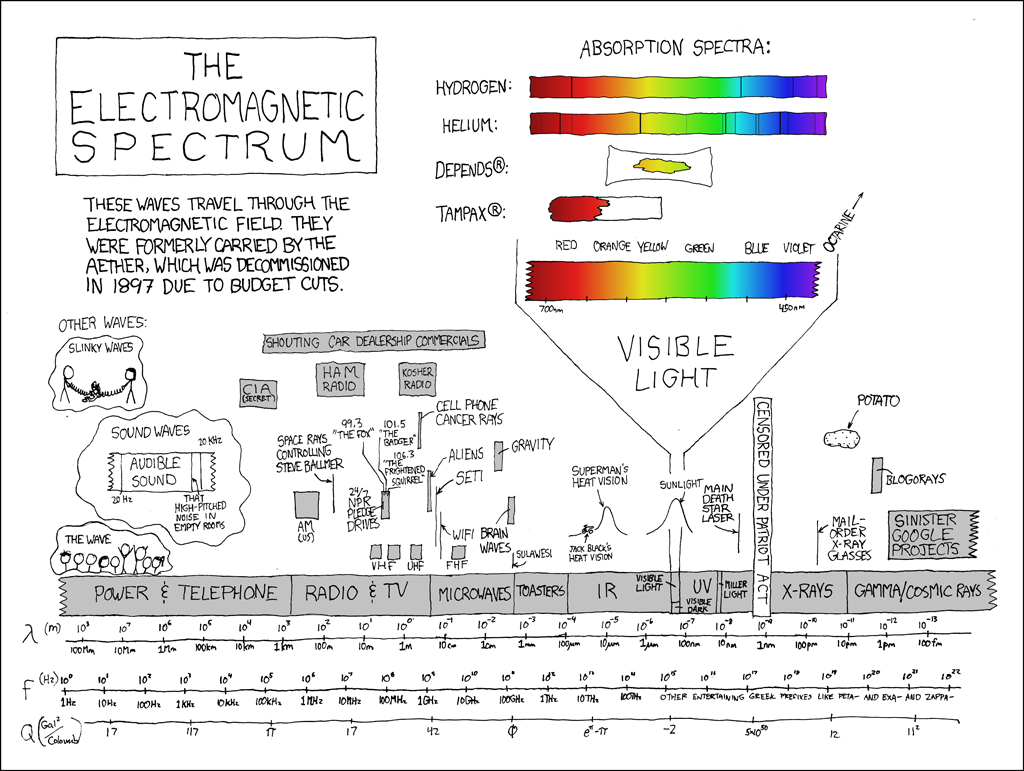
A note about cancer: Cancer is caused by broken, mutated, out-of-control DNA in your cells. The diameter of your DNA and the size of the chemical bonds that hold it all together are about this big: from 0.0000000001 to 0.000000000001 meters (10 e-9 to 10 e-12). This is small.
For cell phones:
Look at where the "cell phone cancer rays" are: right in between radio waves and microwaves, with these long wavelengths of about 1 meter, or near the hight of people. This, though, does not mean cell phones cause cancer in people. It just means that they have relatively low energy: long wavelengths mean low frequency (think about your normal, slow, non-tsunami ocean wave). Since the energy of a wave is proportionate to its frequency, low frequency means low energy. [note: this analogy can be problematic because ocean waves don't care about the whole quantum versus wave nature of photons, which is actually important here (see below), but anyway...]
The converse is also true: short wavelengths mean higher frequency, and higher energy. For example: lithotripsy is a way to treat kidney stones by using ultrasound, with wavelengths in the millimeter range (therefore with a relatively high frequency and high energy). Kidney stones are conveniently around millimeters in size as well. This means that slamming them with microwaves makes the stones resonate, all the sound energy is transferred into kinetic energy in the stones and they shatter. You then drink a lot of water, take a lot of vicodin, and pee out all the little bits.
It would be ridiculous, however, to think you could shatter kidney stones by going surfing. This is because the size of ocean swells are huge compared to the size of kidney stones--You'd sooner drown from paroxysms of pain as the stones pass through your urethra since you should have been in the hospital. This is similar to believing that using a cell phone can cause cancer: the wavelengths are simply too large to affect DNA and chemical bonds. Microwaves (the size of people), simply cannot cause cancer, but higher energy waves can.
For the Fukushima power plant:
Some of the fissile material leaking from the Fukushima power plant that people are freaking out about are caesium-137 and iodine-131. Both emit radiation in the gamma-ray range, which has a super short wavelength: about 0.000000000001, or 10e-12 meters.
This kind of radiation has super high energy. Gamma rays are smaller than DNA and the chemical bonds that hold them together, but it turns out that light with wavelengths less than 10e-9 meters (or UV light) have enough energy to be ionizing, and this is why they're so dangerous: ionizing energy can strip electrons off of atoms, which in turn can break the bonds holding your DNA together, which can cause mutations, and ultimately cancer. Ionizing radiation can of course break other bonds, too, which is why high doses kill cells in general, destroy tissue, cause radiation burns, internal bleeding, and make you feel dead. Similar stuff happens with UVB light when you don't wear sunscreen, if you get too many CT scans, hang around the Hulk, etc. [And an important bit here of course is high doses. That dispersing fart video really does a good job putting it in perspective]
So here's a recap! The following is true:
Cannot cause cancer: long wavelengths, non-ionizing radiation, visible light, radio waves, power lines or telephone lines, cell phones, microwave ovens, WiFi, CRT screens, rainbows, a slinky
wavelengths: greater than 10000000 meters to ~ 0.00000001 meters
Can cause cancer: short wavelengths, ionizing radiation, too many X-rays or CT scans, gamma rays, UV-B rays and sunbathing, Sinister Google Projects, the hulk, Iodine 131
wavelengths: ~ 0.000000001 to less than 0.000000000001 meters
DNA, chemical bonds, and electrons: around 0.000000001 to 0.000000000001 meters
Final thoughts:
Regarding amplitude:
for electromagnetic waves the amplitude is analogous to the number of photons being emitted. The quantum energy of each photon is fixed, however, and is specific to its wavelength/frequency. The amplitude (or number of photons) therefore does not change the frequency/wavelength of the wave, so using a thousand cell phones at once still cannot cause cancer, but it will make you look dumb. ALSO, for the number of photons to really change the intensity of light they ought to be coherent for all their wavelengths to add up right and not be all noisy, therefore: LASERS! Also, this is why tidal waves would appear to have so much energy: all of the amplitude is in a single, coherent, giant tsunami-laser.
Regarding microwave ovens:
The microwaves used in microwave ovens are a lot smaller than those in cellphones: instead of a wavelength of a meter they're around a few millimeters. This gets a bit more complicated as these microwaves heat food due to the polar nature of water and not so much because of the wavelengths of microwaves interacting with things of similar size. BUT! Those little holes in the front of microwaves? Those are there because the 2.5 GHz microwaves used in the ovens have a wavelength just a little bit bigger than the holes, so they can't get through and out to boil your brain! I love that shit.
BUT! Even without those holes, the microwaves still wouldn't cause cancer in your brain. They would just boil the water in your brain. That's all. But they don't. Because they're completely blocked. So use a microwave. It's fine.
Regarding the Fukushima scare:
Iodine masks are like holographic bracelets and prayer. Use them excessively or not at all. Iodine pills are useful if you live next to a melting nuclear reactor, they are unnecessary if you are not. Americans are still mostly jerks about things. I have yet to see a story about the Fukushima 50 which doesn't also list the A-list actors who should play them in the Hollywood movie they've already started production on.
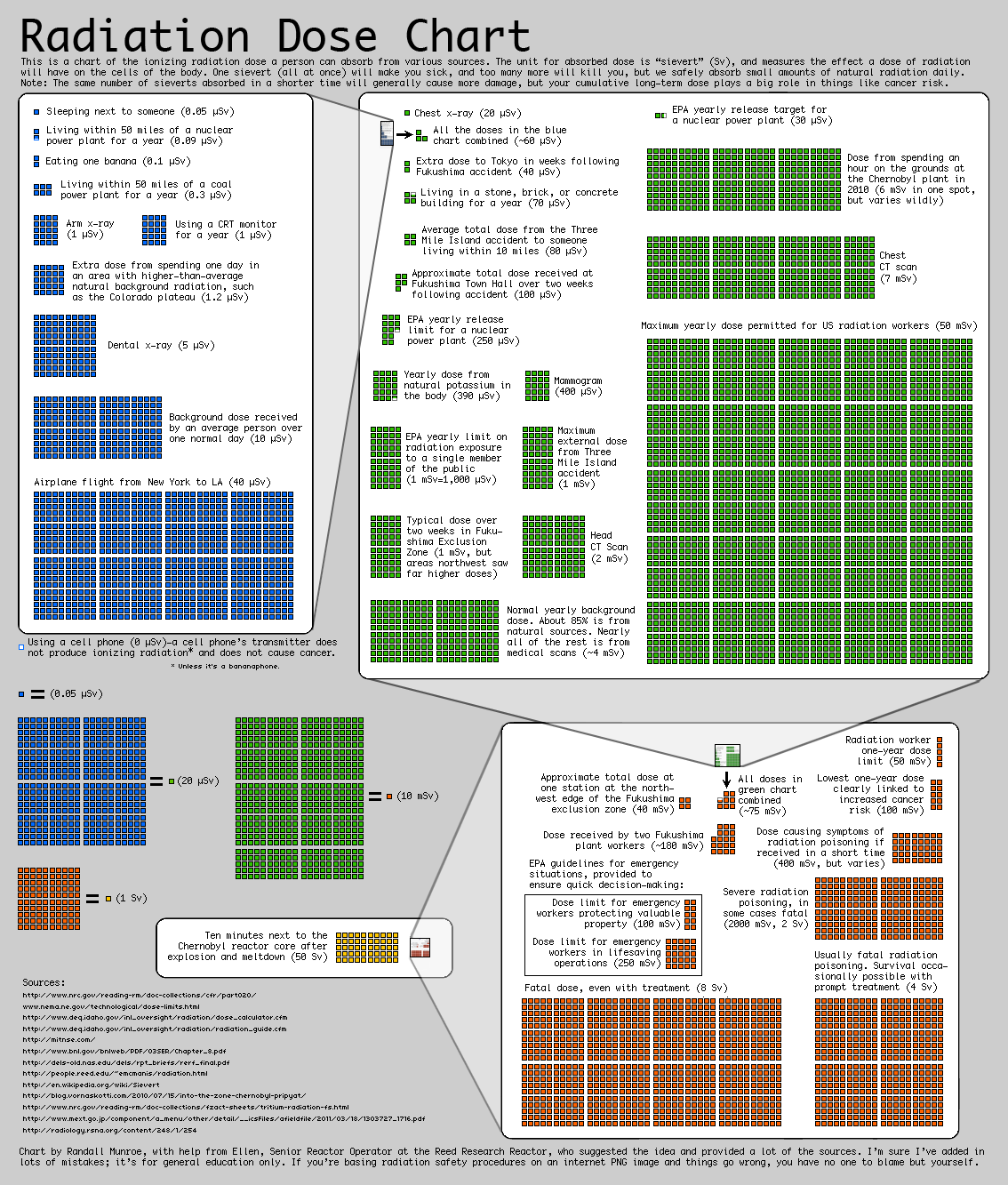
Update! XKCD made this amazing graph of radiation exposure. Seriously puts things into perspective:
Update!
XKCD likes his stuff under a Creative Commons license, so, free and legal to use for non-commercial purposes!